




Sawday Shares Significance of Nothingness at James Russell Lowell Prize Ceremony


01/16/2025
A lot can be said about the blank spaces in literature.
That was one of the messages from Jonathan Sawday, Ph.D., SLU’s Walter J. Ong, S.J. Chair in Humanities in the English Department. Wednesday afternoon, a standing-room-only crowd gathered in the Pere Marquette Gallery to hear Sawday’s thoughts on his award-winning text, Blanks, Print, Space, and Void in English Renaissance Literature: An Archaeology of Absence.
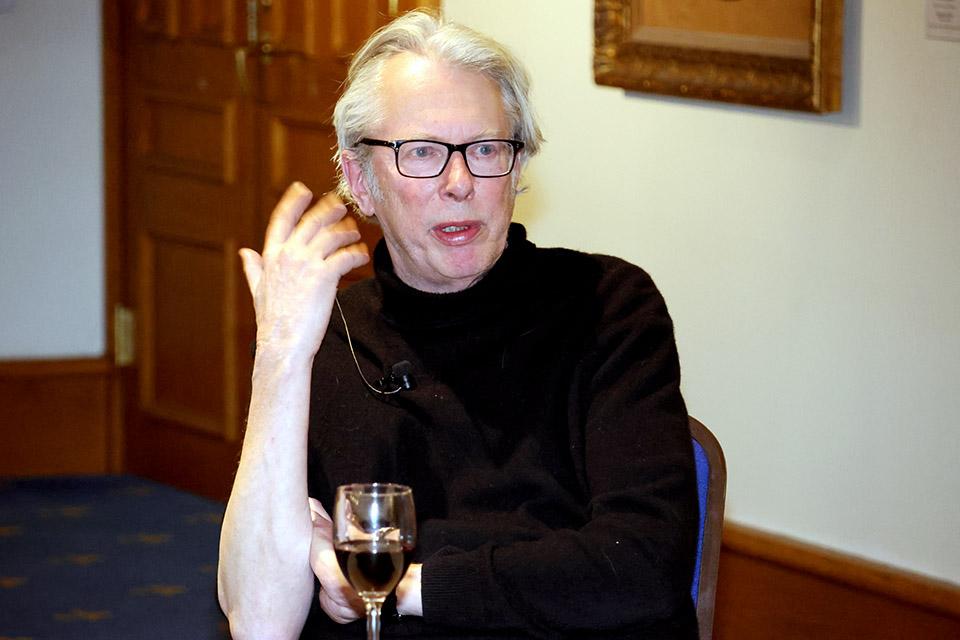
Jonathan Sawday, Ph.D., responds to a question during an event on Wednesday, Jan. 15. Photo by Joe Barker.
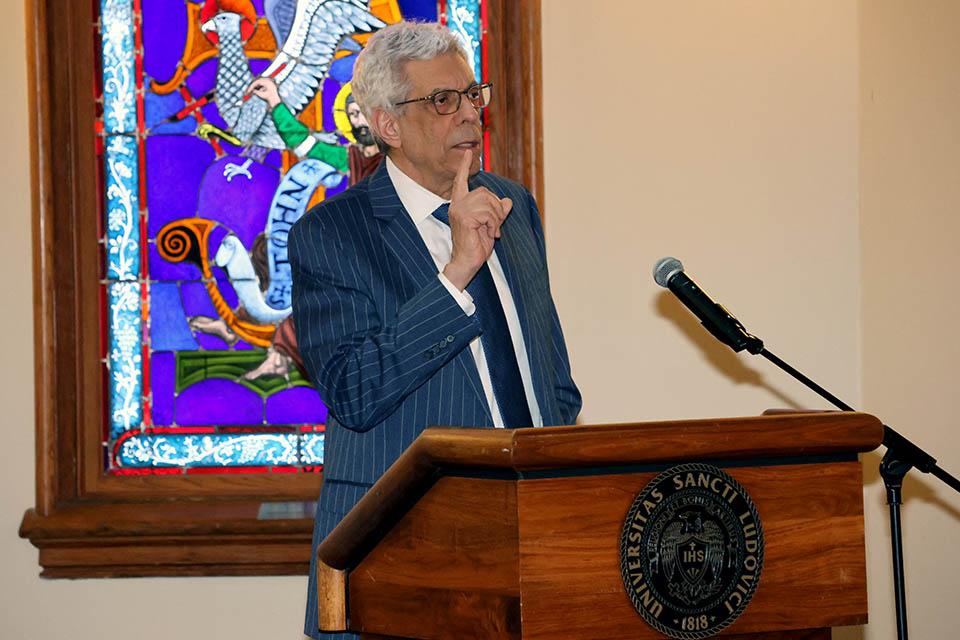
SLU President Fred P. Pestello, Ph.D., praised James Russell Lowell Prize awardee Jonathan Sawday, Ph.D., during an event Wednesday, Jan. 15. Photo by Joe Barker.
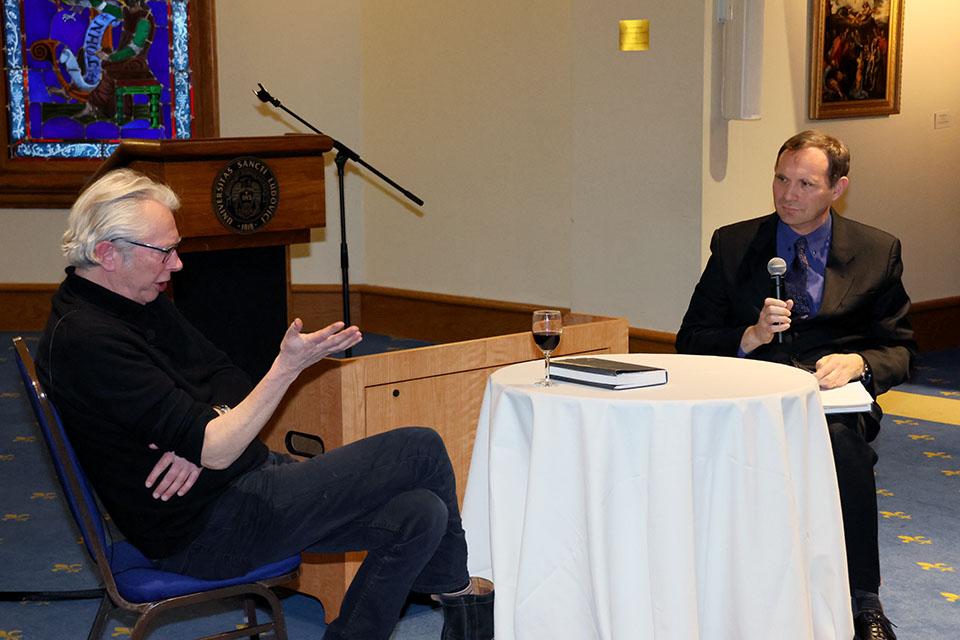
Jonathan Sawday, Ph.D., and chair of SLU's English Department, Brian Yothers, Ph.D., discuss Sawday's work at an event on Wednesday, Jan. 15. Photo by Joe Barker.
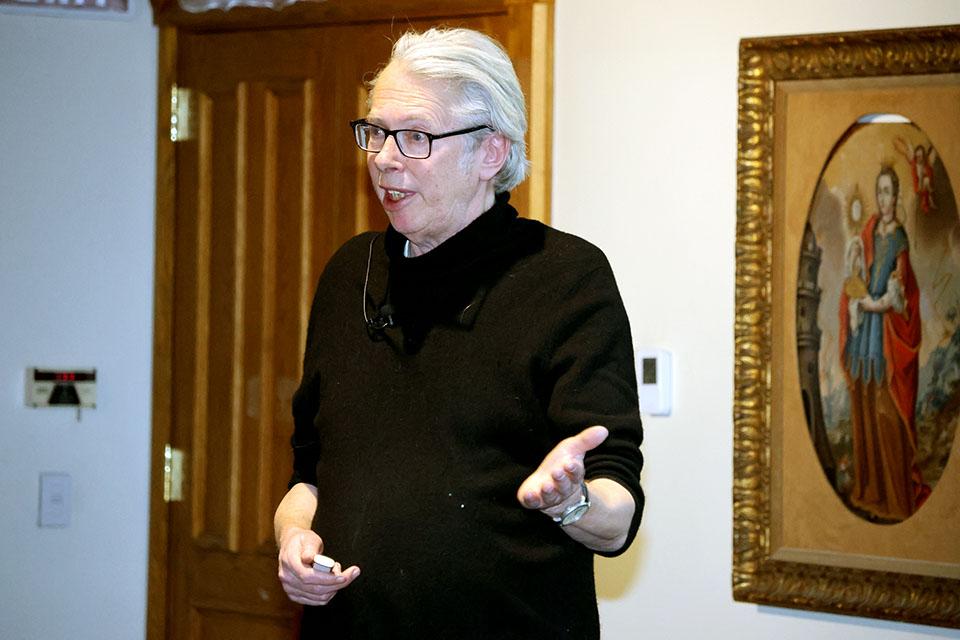
Jonathan Sawday, Ph.D., speaks at a reception on Wednesday, Jan. 15. Photo by Joe Barker.
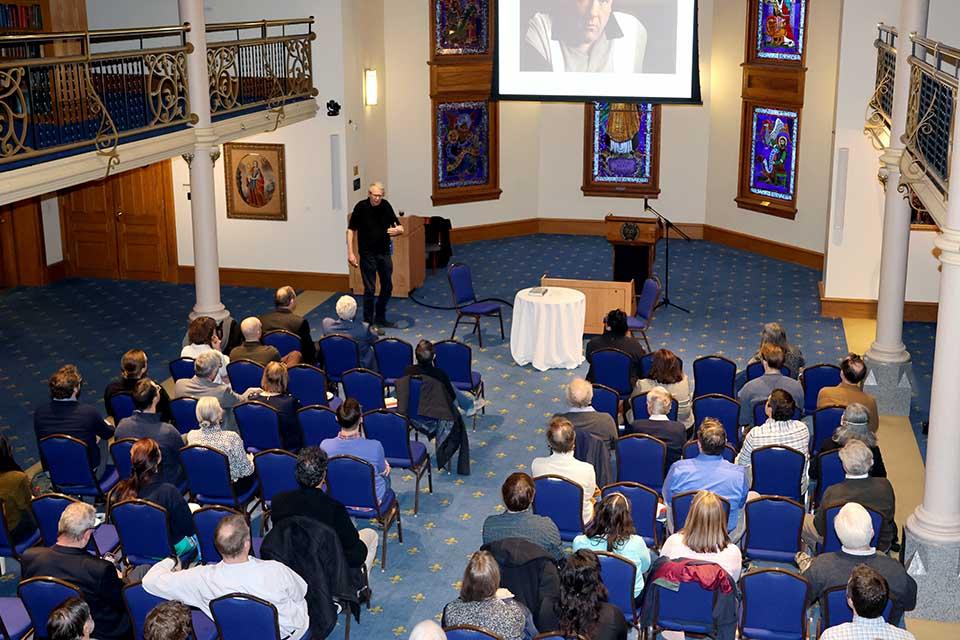
Jonathan Sawday, Ph.D., talked about his award-winning book, Blanks, Print, Space, and Void in English Renaissance Literature: An Archaeology of Absence, at an event on Wednesday, Jan. 15. Photo by Joe Barker.
The event was a celebration of Sawday’s recent reception of the James Russell Lowell Prize for the most outstanding book published in 2023, for his book published by Oxford University Press. The prize is the Modern Language Association’s (MLA) top honor and is awarded each year to an outstanding book that is a literary or linguistic study, a critical edition of an important work, or a critical biography written by a member of the association.
Sawday is the 55th recipient of the award, and the first from SLU to receive the honor.
“This is an extraordinary achievement,” said SLU President Fred P. Pestello, Ph.D. “Truly, this is something special. When Jonathan talks about this truly magnificent book, he often quips that he wrote 600 pages about nothing. It’s a very good line, but this achievement signifies quite a lot more than nothing.”
Sawday opened his remarks by talking about one of his inspirations for the project — the famous cut-to-black series finale of the TV show “The Sopranos.” Sawday talked about how that famous black screen, a void, actually said something.
“I was watching back in the U.K. and I thought it was just amazing,” Sawday said. “. . . It was tracing people’s response to this blackness that got me thinking there’s something interesting going on here, something worth writing about.”
Sawday noted that his book connects many aspects of contemporary culture with the advent of the transformative technology of print in the sixteenth and seventeenth centuries.
“It’s a book about history, a book about print history from the first age of print,” he said.
Blank spaces evolved over time. Sawday noted that the earliest printing was done without spaces between words — every word was just mashed together. This led to reading out loud. Once printers started separating words with spaces, silent reading began, some historians believe.
Blank spaces also could tell a story by themselves. In one example, Sawday showed an early map of North America with large swaths of empty spaces over the continent. He pointed out that this space was not blank — it was filled with wildlife, nature, and notably people. However, in trying to promote the new world to Europeans, map makers sold settlers visions of filling those voids.
“America is being shown as vacant, empty,” he said. “That sort of functions a bit like a vacuum. There is a political point being made — this place is empty, come here.”
Sawday connected things like modern tax forms to early documents. The modern printed “blank form,” devised with spaces that must be filled in by the user, and which first began to be issued in enormous numbers in the sixteenth century, is part of what the book calls the “rhetoric of the blank.”
Eventually, writers and poets started playing with the blank spaces. Sawday pointed to one example where an author used marks to mimic blood drops falling on a page.
“Those little spots on the page are a representation of blood, Christ’s blood, being imagined to fall on the page,” he said. “The reader is being drawn in through this manipulation of time and space.”
Sawday talked about censorship and also the connection between printing and race — he noted many modern ideas about “race” were shaped, in part, by the oscillation between black and white which was the product of the “inky” technology of print.
Sawday closed the celebration by taking questions from Brian Yothers, Ph.D., professor and chair of the Department of English at SLU, and members of the audience.
Sawday thanked the SLU community for making the book possible.
“This book is a very SLU book in the sense that so many of my colleagues helped me to write it,” Sawday said.
Latest Newslink
- SLU Research Shows Surge in Alcohol-Related Liver Disease Driving ‘Deaths of Despair’Researchers at Saint Louis University School of Medicine say deaths from alcohol-related liver disease have surged in recent years, and the increase is hitting people without a college degree the hardest. While nearly every demographic group is seeing higher death rates—including those with college degrees—the gap between economically disadvantaged groups and more affluent ones is growing, according to new research.
- Saint Louis University Joins Multi-Disciplinary Research Team to Enhance Stress Resilience in SorghumSaint Louis University is part of a multi-disciplinary team, led by the Donald Danforth Plant Science Center, to deepen the understanding of sorghum, a versatile bioenergy crop, and its response to environmental challenges.The U.S. Department of Energy (DOE) Biological and Environmental Research (BER) program supports the three-year $2.5 million project for Genomics-Enabled Understanding and Advancing Knowledge on Plant Gene Function. Saint Louis University will receive $437,039 for its portion of the study.
- SLU Graduates Celebrated at Midyear CommencementSaint Louis University celebrated its Midyear Commencement on Saturday, Dec. 13, inside Chaifetz Arena. More than 1,900 guests watched as 600-plus SLU students walked across the stage and left as graduates.
- Why Do Raccoons Cross the Road? SLU, St. Louis Zoo Research Shows They Don'tA new study led by researchers from Saint Louis University, the Saint Louis Zoo, and partner organizations set out to understand how raccoons use space in one of the nation's largest urban parks.
- Structurally Sound: Two Gingerbread Houses Built by SSE Students Hold Up Under 100-Plus Pounds of WeightTeams of students, faculty and staff in Saint Louis University's School of Science and Engineering recently put their engineering skills to work for a December Innovation Challenge, building gingerbread houses designed to stand up during a weight-loading competition.
- Saint Louis University Student Speaks at Ignatian Family Teach-In for JusticeSaint Louis University senior Sahar Hussaini shared her views on fast consumerism and why she believes in Catholic Ethical Purchasing at the 2025 Ignatian Family Teach-In for Justice. The event, held annually in Washington, D.C., is the nation’s largest Catholic social justice advocacy day.