




SLU Study: Immune Dysfunction Increases Cancer Risk in Obese Populations


11/14/2024
ST. LOUIS —Researchers at Saint Louis University’s School of Medicine say T-cell dysfunction is leading to an increased risk of cancer in obese populations.
T cells are white blood cells called lymphocytes essential to your immune system in the fight against infections and cancer. Ryan Teague, Ph.D., professor of molecular microbiology and immunology at SLU, and his team are exploring why obesity impacts T-cell dysfunction and compromises immune surveillance, or the body’s ability to survey malignant cells and clear them before they become tumors.
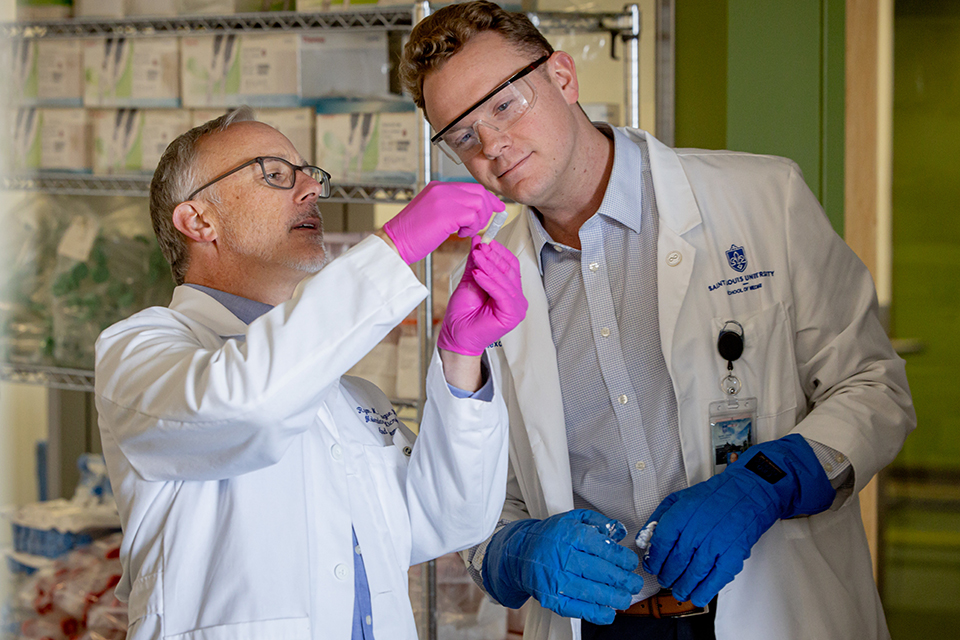
Ryan Teague, Ph.D., left, and Alex Piening, an M.D./Ph.D. graduate student at SLU, work in the lab in Doisy Research Center on October 21, 2024. Photo by Sarah Conroy.
The study, which was led by Teague and co-authored by Alex Piening, an M.D./Ph.D. graduate student at SLU, was recently published in Nature Communications, found that T-cell dysfunction linked to obesity prevented T cells from detecting tumor cells, placing obese mice at higher risk of developing tumors when exposed to a carcinogen. Teague and his team are now trying to uncover the exact mechanism underlying the metabolic dysfunctions associated with obesity that directly impact T-cell function.
Ongoing projects in Teague’s lab at SLU are designed to identify barriers to successful cancer immunotherapy and develop strategies to overcome these barriers for improved patient outcomes. Teague and his team investigate how obesity impacts the efficacy of immunotherapies.
"Immunotherapy boosts a patient's immune system by targeting T cells and reinvigorating them. Paradoxically, immunotherapy is often more successful in patients with obesity, where the immune system isn’t functioning quite as well," Teague said. "Our research explains this paradox by showing that in the setting of obesity, developing tumors are only required to escape a weakened immune system. Such outgrown tumors are not well adapted to evade the reinvigorated T cells elicited during immunotherapy, and thus, are more easily destroyed."
Teague said single-cell RNA sequencing played a critical role in the study’s findings, which allowed scientists to learn what’s happening inside individual immune cells within tumors.
"We learned that the dysfunction in these T cells lies in their inability to kill tumors. Those genes were not being turned on. It also lies in their inability to acquire the metabolic functions needed to sustain anti-tumor activity," Teague said.
Thanks to SLU’s investment in single-cell RNA sequencing technology, the Department of Molecular Microbiology and Immunology has leveraged this new approach to advance its work studying cancer and the immune system, bringing us closer to new cures.
Other authors include Kelly D. Pyles, Kyle S. McCommis, Ph.D., Department of Biochemistry and Molecular Biology, Saint Louis University School of Medicine; Emily Ebert, Carter Gottlieb, Niloufar Khojandi, Lindsey M. Kuehm, Stella G. Hoft, Richard J. DiPaolo, Ph.D., Stephen T. Ferris, Ph.D., Elise Alspach, Ph.D., Department of Molecular Microbiology and Immunology, Saint Louis University School of Medicine.
Latest Newslink
- SLU Launches William L. Clay, Sr. Institute of Civic Engagement and Economic JusticeThe Clay Institute will provide immersive learning experiences and hands-on training that address the social and economic challenges facing the St. Louis region and the nation. Institute programming will be available to all students with an interest in civic engagement and democratic participation.
- SLU Research Explores Depression's Ripple Effect on DiabetesA study conducted by researchers at Saint Louis University found that patients with depression were more likely to have uncontrolled diabetes over time and that depression contributes to a heightened economic burden to diabetes management.
- SLU/YouGov Poll: Statewide Cell Phone Ban for Missouri Schools Popular with VotersGovernor Mike Kehoe has signed Senate Bill 68 into law, enacting a statewide ban on the use of personal electronic devices, including cell phones, tablets, and smartwatches, throughout the school day in Missouri public and public charter schools.
- SLU Vaccine Center Will Enroll Healthy Volunteers in Yellow Fever Vaccine Clinical TrialSaint Louis University's Center for Vaccine Development will enroll up to 70 adult volunteers in a clinical trial to study the safety elicited by a new investigational vaccine for yellow fever, a potentially deadly disease that is spread by mosquitoes. The research is funded by Sanofi Pasteur.
- Feser Joins Global Jesuit Assembly During First Week as SLU's PresidentAs he began his tenure as Saint Louis University's 34th president, Edward Feser, Ph.D., represented SLU as a delegate at the 2025 Assembly of the International Association of Jesuit Universities (IAJU).
- SLU Partnership with St. Louis Catholic Academy Middle School Education Yields Improved Outcomes One Year OnA partnership between Saint Louis University's School of Education's Herrmann Center for Innovative Catholic Education and St. Louis Catholic Academy has yielded improved test scores and student outcomes in the middle school population after its first year. The SLU School of Education provides resources to St. Louis Catholic Academy's middle school.