




SLU’s Alec Pollard Receives International OCD Foundation Outstanding Career Achievement Award


Alec Pollard, Ph.D., professor emeritus of family and community medicine at Saint Louis University School of Medicine, recently received the International OCD Foundation (IOCDF)’s 2024 Outstanding Career Achievement Award.
Nominees are selected from the IOCDF’s Scientific and Clinical Advisory Board who have been active participants in the field of obsessive-compulsive disorder (OCD) and related disorders for at least 20 years. The IOCDF Awards recognize exceptional individuals and professionals for their dedicated efforts in advancing awareness, advocacy, and understanding of OCD.
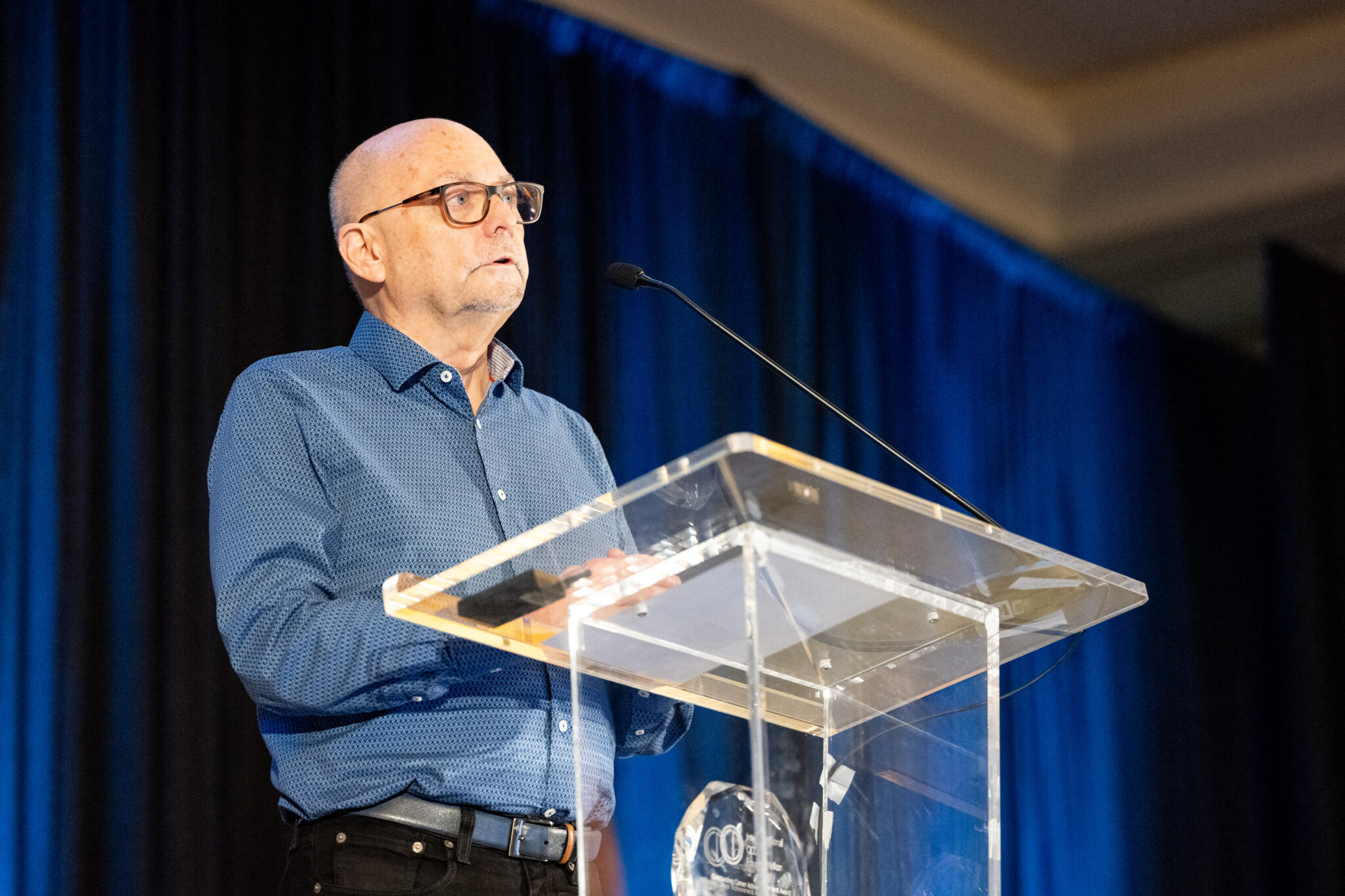
Alec Pollard, Ph.D., professor emeritus of family and community medicine, addresses an audience after receiving the International OCD Foundation’s 2024 Outstanding Career Achievement Award. Photo by the International OCD Foundation.
The awards were presented at IOCDF’s 29th Annual OCD Conference—a unique gathering that brings together individuals with OCD, their families, supporters, treatment providers, and researchers for programming, support groups, learning, and celebrations weekend. OCD affects up to 280 million people worldwide, including 80 million kids.
Pollard is a licensed psychologist who has treated OCD and related disorders for over 40 years, with a particular interest in obstacles that inhibit the pursuit of recovery or interfere with effective participation in treatment. He has taught more than 450 mental health professionals how to properly treat people suffering from OCD.
“Our goal is decreasing that gap, so all OCD sufferers have a chance to learn how to manage their OCD symptoms. That starts with the doctors who treat them,” Pollard said. “It’s an honor to work with people who are so dynamic and hungry for information.”
Pollard is a licensed psychologist who works with a range of obsessive-compulsive and anxiety-related disorders, with a special interest in patients ambivalent about or resistant to therapy. In 1982, he established the Center for OCD and Anxiety-Related Disorders (COARD), an internationally recognized, multidisciplinary program for a wide range of anxiety disorders at Saint Louis University School of Medicine. In 1995, he launched the Saint Louis Behavioral Medicine Institute (SLBMI), an academic affiliate of SLU’s Doisy College of Health Sciences, where he serves as founding director.
Pollard’s legacy consists of treating the whole family system and Treatment Readiness Therapy (TRT), a therapeutic approach developed at the SLBMI. OCD affects up to four million people in the United States. Yet, there is a shortage in the number of therapists who are trained in Cognitive Behavior Therapy, the most widely accepted treatment for OCD. According to foundation research, it takes an average of 14 to 17 years from the onset of OCD symptoms for a person to receive effective treatment. In many cases, poor response to therapy is the result of failure to address treatment-interfering behavior.
Pollard graduated in 1981 from the California School of Professional Psychology-San Diego with a Ph.D. in clinical psychology and received postdoctoral training in anxiety disorders at the Behavior Therapy Unit at Temple University Health Sciences Center. Pollard was mentored by Edna Foa, Ph.D., professor of clinical psychology in psychiatry at the University of Pennsylvania and director of the Center for the Treatment and Study of Anxiety, who is currently one of the world’s leading experts on OCD and related disorders. Joseph Wolpe also mentored him, who was recognized as one of the founders of behavior therapy.
Pollard serves on the Scientific Advisory Board of the International OCD Foundation and chairs the organization’s national training initiative: the Behavior Therapy Training Institute. Pollard also serves on the Scientific Advisory Committee of the Canadian Institute for Obsessive-Compulsive Disorders and the Obsessive-Compulsive Cognitions Working Group research collaborative and is the former chair of the Clinical Advisory Board of the Anxiety and Depression Association of America. He serves as a reviewer for a number of professional journals and conference program committees and has authored more than 100 publications, including three books: When a Loved One Won’t Seek Mental Health Treatment, The Agoraphobia Workbook, and Dying of Embarrassment: Help for Social Anxiety & Phobia.
Latest Newslink
- Saint Louis University Joins Multi-Disciplinary Research Team to Enhance Stress Resilience in SorghumSaint Louis University is part of a multi-disciplinary team, led by the Donald Danforth Plant Science Center, to deepen the understanding of sorghum, a versatile bioenergy crop, and its response to environmental challenges.The U.S. Department of Energy (DOE) Biological and Environmental Research (BER) program supports the three-year $2.5 million project for Genomics-Enabled Understanding and Advancing Knowledge on Plant Gene Function. Saint Louis University will receive $437,039 for its portion of the study.
- SLU Graduates Celebrated at Midyear CommencementSaint Louis University celebrated its Midyear Commencement on Saturday, Dec. 13, inside Chaifetz Arena. More than 1,900 guests watched as 600-plus SLU students walked across the stage and left as graduates.
- Why Do Raccoons Cross the Road? SLU, St. Louis Zoo Research Shows They Don'tA new study led by researchers from Saint Louis University, the Saint Louis Zoo, and partner organizations set out to understand how raccoons use space in one of the nation's largest urban parks.
- Structurally Sound: Two Gingerbread Houses Built by SSE Students Hold Up Under 100-Plus Pounds of WeightTeams of students, faculty and staff in Saint Louis University's School of Science and Engineering recently put their engineering skills to work for a December Innovation Challenge, building gingerbread houses designed to stand up during a weight-loading competition.
- Saint Louis University Student Speaks at Ignatian Family Teach-In for JusticeSaint Louis University senior Sahar Hussaini shared her views on fast consumerism and why she believes in Catholic Ethical Purchasing at the 2025 Ignatian Family Teach-In for Justice. The event, held annually in Washington, D.C., is the nation’s largest Catholic social justice advocacy day.
- SLU Commits up to $1.5 Million to Support Local Students Pursuing Social Work and Criminal Justice CareersThe new initiative — representing a commitment of up to $1.5 million in scholarship support over the next several years — is designed to strengthen the region’s social work and criminal justice workforce by expanding college access for talented local students.