




Amy E. Wright Receives Honorable Mention for MLA's Katherine Singer Kovacs Prize


12/11/2024
ST. LOUIS – Saint Louis University’s Amy E. Wright, Ph.D., received an honorable mention from the Modern Language Association of America (MLA) for the Katherine Singer Kovacs Prize for an outstanding book published in English or Spanish in the field of Latin American and Spanish literatures and cultures.
Wright, a professor of Hispanic Studies at SLU, received the honor for her book Serial Mexico: Storytelling across Media, from Nationhood to Now, published in 2023 by Vanderbilt University Press.

Amy E. Wright, Ph.D.
The 2024 Kovacs Prize was awarded to Catherine Brown, professor of comparative literature and the Residential College at the University of Michigan, Ann Arbor, for Remember the Hand: Manuscription in Early Medieval Iberia, published by Fordham University Press. Sharing honorable mention honors with Wright is Isabel C. Gómez, associate professor of Latin American and Iberian studies at the University of Massachusetts, Boston, for Cannibal Translation: Literary Reciprocity in Contemporary Latin America, published by Northwestern University Press.
“I am deeply honored to receive this honorable mention,” Wright said. “I am humbled to be included in this impressive cohort of scholars. This recognition is particularly meaningful to me a it highlights the importance of rigorous scholarship and the celebration of diverse cultural narratives.”
The MLA award committee’s citation notes, “Amy E. Wright’s Serial Mexico: Storytelling across Media, from Nationhood to Now is a masterful analysis of transmedial serial storytelling. The book is well conceived and plotted, knitting together cogent analyses of nation as family, the relationship of popular form (in this case seriality) to the solidification of identity, and the paradoxical use of an anti-establishment antihero to push normativity. Serial Mexico will likely serve not only as a reference for future studies of serial storytelling in nineteenth- through twentieth-century Mexico but also as a point of orientation for scholarship seeking to cross geographies and broad time scales through their interrupted, periodical production. Wright offers smart, capacious, careful, innovative analyses of how the form of serialized narrative works in Mexico across time, shaping popular consumer engagement with a variety of texts, from radionovelas to comics to podcasts.”
Wright received an individual fellowship from the National Endowment for the Humanities (NEH) in 2022 to support the writing of the book. The highly competitive NEH fellowships recognize exceptional humanities projects on the national level, annually awarded through the United States government. The fellowships support advanced research in the humanities, with recipients producing award-winning books, digital materials or other scholarly resources.
Each year the NEH receives an average of 1,100 applications for individual projects and has a 7% funding ratio, awarding only some 70 individual fellowships out of the applications received.
Wright received her bachelor's degree from the University of North Carolina at Chapel Hill and her master’s and doctorate at Brown University. Her research explores print culture in Mexico, popular seriality in Latin America, Latin American literary and cultural history and media studies in Mexico.
Serial Mexico: Storytelling across Media, from Nationhood to Now
Serial Mexico draws on a range of archives, historical records, and popular culture to show the resilience and breadth of serial storytelling in Mexico, from its founding to the present. The panorama shows the Mexican experience of storytelling, showcasing protagonists that mock authority, make light of hierarchy, and embrace the hybridity and mestizaje of Mexico. These tales reflect on and respond to crucial cultural concerns such as family, patriarchy, gender roles, racial mixing, urbanization, modernization, and political idealism.
“Many countries have serialized storytelling or characters that reappear in different forms,” Wright said. “Mexico has a particularly strong tradition, beginning with characters that come from the oral traditions and take on a life outside of their original story.”
Serial Mexico examines how serialized storytelling’s melodrama and sensationalism reveal key political and cultural messaging. The book explores the long-running intrigues of serial novels, comics, radio dramas, and telenovelas, as well as blogs and podcasts – while advancing new approaches to the study of Mexican culture and history.
The MLA will present awards and honor winners at its annual meeting in New Orleans on January 9-12.
About the Modern Language Association of America
The Modern Language Association of America and its over 20,000 members in 100 countries work to strengthen the study and teaching of languages and literature. Founded in 1883, the MLA provides opportunities for its members to share their scholarly findings and teaching experiences with colleagues and to discuss trends in the academy. The MLA sustains one of the finest publication programs in the humanities, producing a variety of publications for language and literature professionals and for the general public. The association publishes the MLA International Bibliography, the only comprehensive bibliography in language and literature, available online. The MLA Annual Convention features 750 scholarly and professional development sessions. More information on MLA programs is available at www.mla.org.
About the Katherine Singer Kovacs Prize
The Katherine Singer Kovacs Prize was established in 1990 by a gift from Joseph and Mimi B. Singer, parents of the late Katherine Singer Kovacs and is awarded under the auspices of the MLA’s Committee on Honors and Awards. Katherine Singer Kovacs completed her undergraduate studies at Tufts University, where she was elected to Phi Beta Kappa, and earned her MA and her PhD (in 1974) at Harvard University. She is the author of “Le Rêve et la Vie”: A Theatrical Experiment by Gustave Flaubert and articles and reviews on Latin American literature, culture, and film and on comparative literature. Kovacs was a specialist in Spanish and Latin American literature and film. She taught at Stanford University, the University of Southern California, and Whittier College. She was associate editor and coeditor of Humanities in Society, a member of the executive committee of the Quarterly Review of Film Studies, and a consultant for Latin American Perspectives. Kovacs died in May 1989.
Latest Newslink
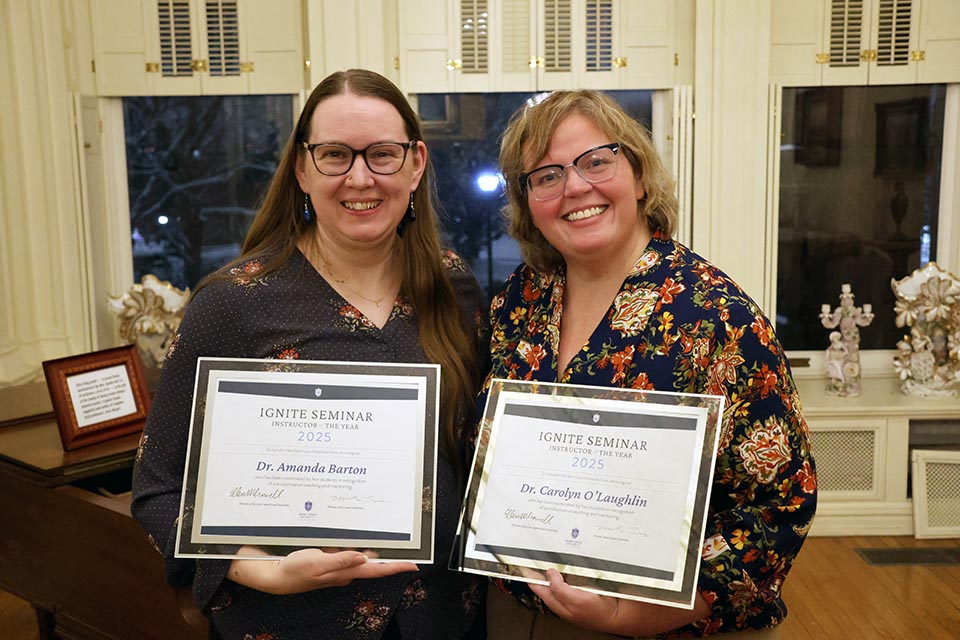
- University Core Honors Ignite Seminar InstructorsTwo Ignite Seminar instructors have been recognized with the 2025 Ignite Instructor of the Year Award. At a ceremony Tuesday night in Cupples House, Carolyn O'Laughlin, Ph.D. (Education) and Amanda Barton, Ph.D. (RISE Counselor) were honored by the University Core after being nominated by students in their Ignite Seminars.
- Sharing Throughout the Season: Ways to Give Back at SLUThis holiday season, Saint Louis University is highlighting organizations that could benefit from the gift of time or donations, including the University's annual Blue Santa toy drive.
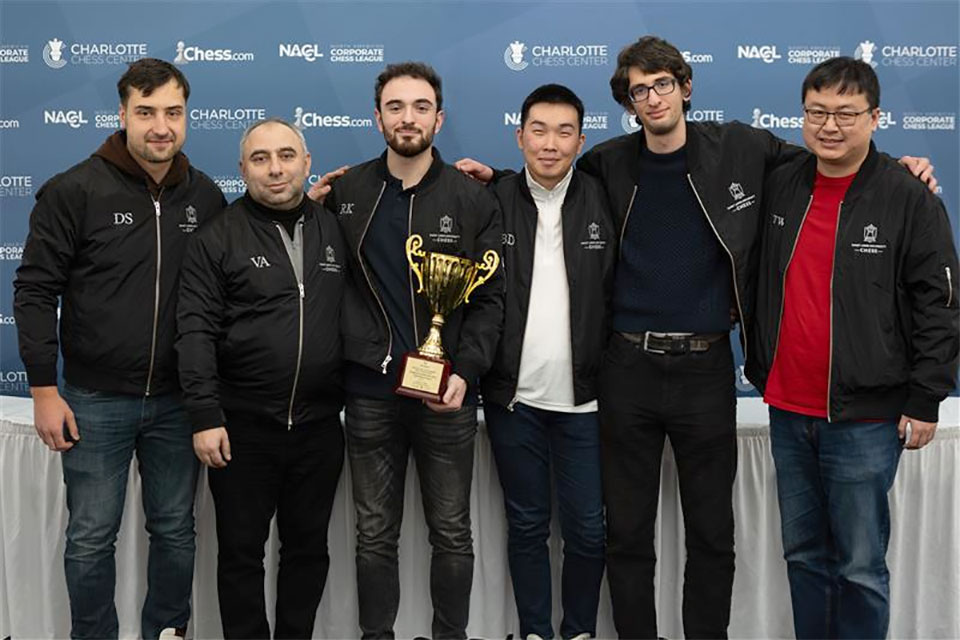
- SLU Wins Collegiate Chess League Back-to-Back SeasonsThe SLU Chess Team won back-to-back Collegiate Chess League titles, securing the Fall 2025 season championship. This win is SLU's fifth Collegiate Chess League title in the last six seasons.
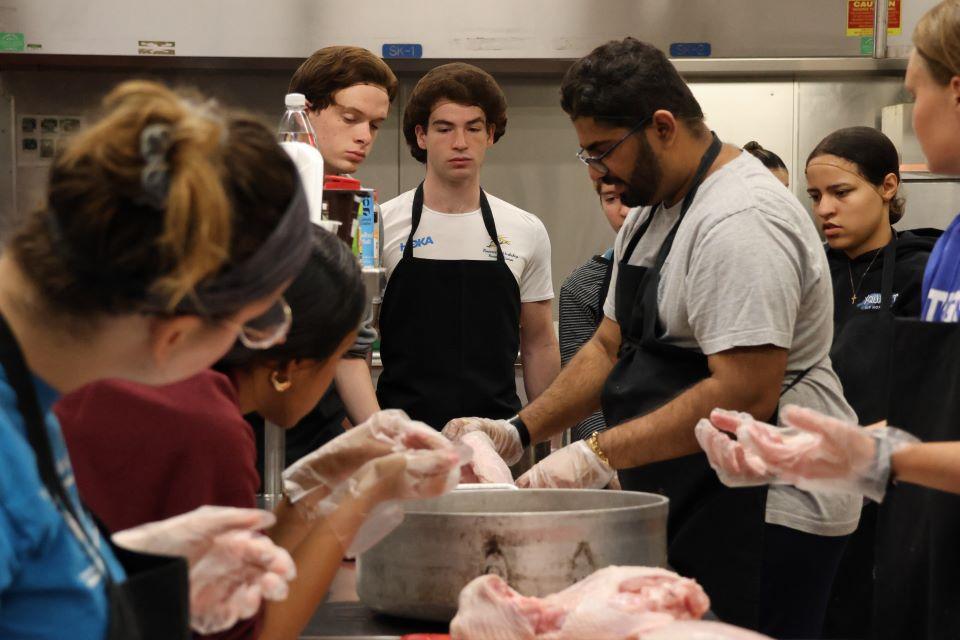
- TurkeyPalooza Food Drive Helps Provide a Thanksgiving Meal to Individuals, Families in NeedTurkeyPalooza, the annual Campus Kitchen food drive and Thanksgiving food prep event, resulted in 200 individual Thanksgiving meals and 40 meal-prep boxes for families in the St. Louis community.
- Saint Louis University's Moore Honored by Missouri Lawyers WeeklySenior Associate General Counsel Christina Moore, J.D., has been recognized by Missouri Lawyers Weekly for her work as in-house counsel at a non-profit or government organization. Moore (Law '02) was honored at the In-House Counsel Awards, an event designed to recognize attorneys from different sectors for their contributions and work.
- SLU Study Shows Heat Can Cut Insect Survival but Boost ReproductionRising global temperatures are changing the rules for survival—and reproduction—for many species. A new study from Saint Louis University reveals that predicting which species will persist under climate change is more complex than focusing solely on survival.