




Leaders Tout Teamwork for Geospatial Success in St. Louis


09/13/2024
The future of geospatial work in St. Louis is collaboration.
Thursday morning, a record crowd attended the sixth Geo-Resolution conference at Saint Louis University. The annual event, co-hosted by the National Geospatial-Intelligence Agency and SLU, was focused this year on the future — the event’s theme was "Modeling the Future for Today's Decisions."
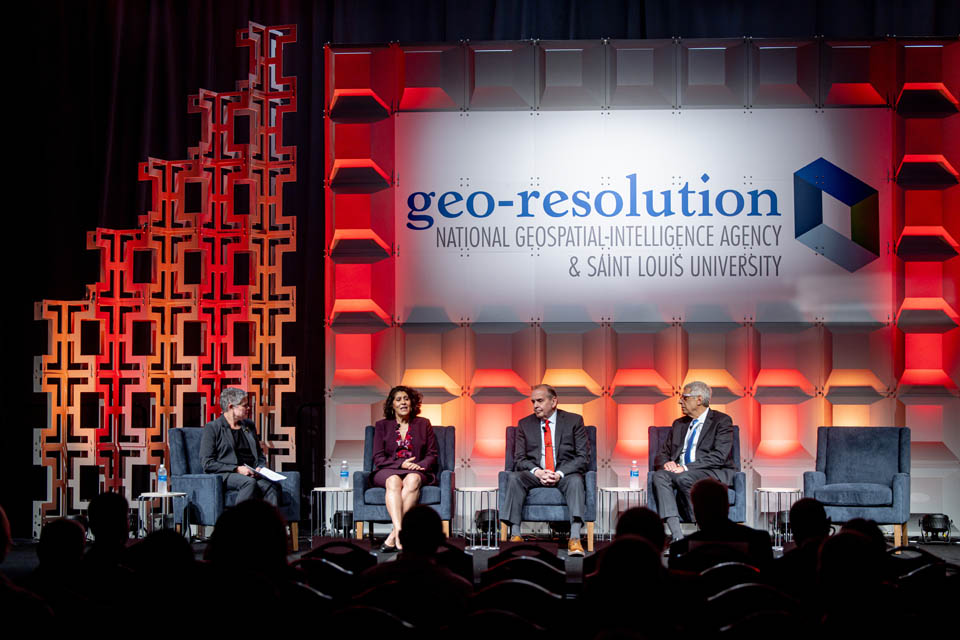
The Leaders Look panel of the Geo-Resolution Conference on Sept. 12, 2024. Photo by Sarah Conroy.
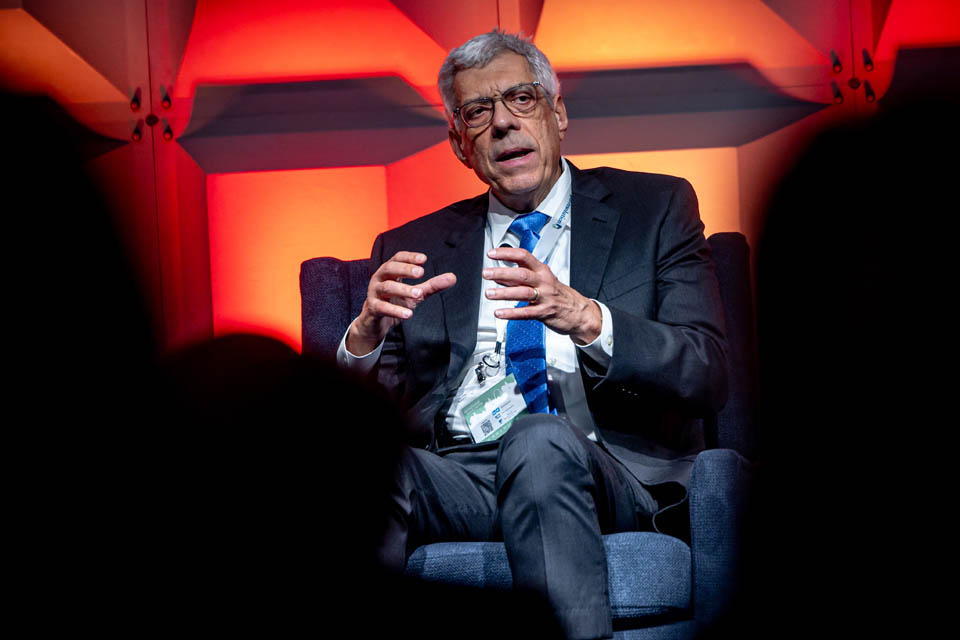
President Fred P. Pestello, Ph.D., speaks on the Leaders Look panel during the Geo-Resolution Conference on Sept. 12, 2024. Photo by Sarah Conroy.
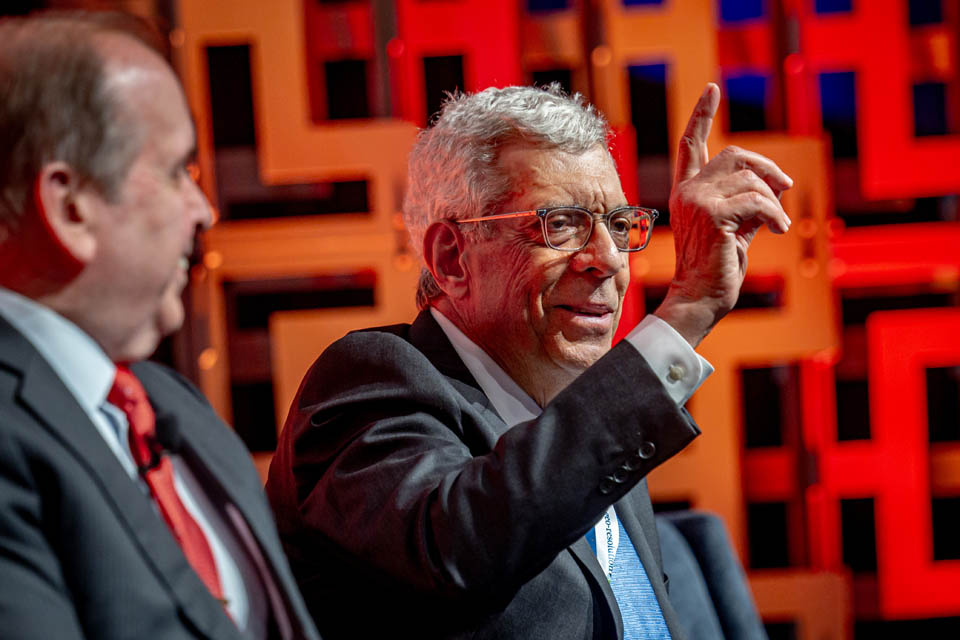
President Fred P. Pestello, Ph.D., right, speaks as William Caniano, West Executive and director of the office of corporate communications of the National Geospatial-Intelligence Agency, left, listens during the Leaders Look panel of the Geo-Resolution Conference on Sept.12, 2024. Photo by Sarah Conroy.
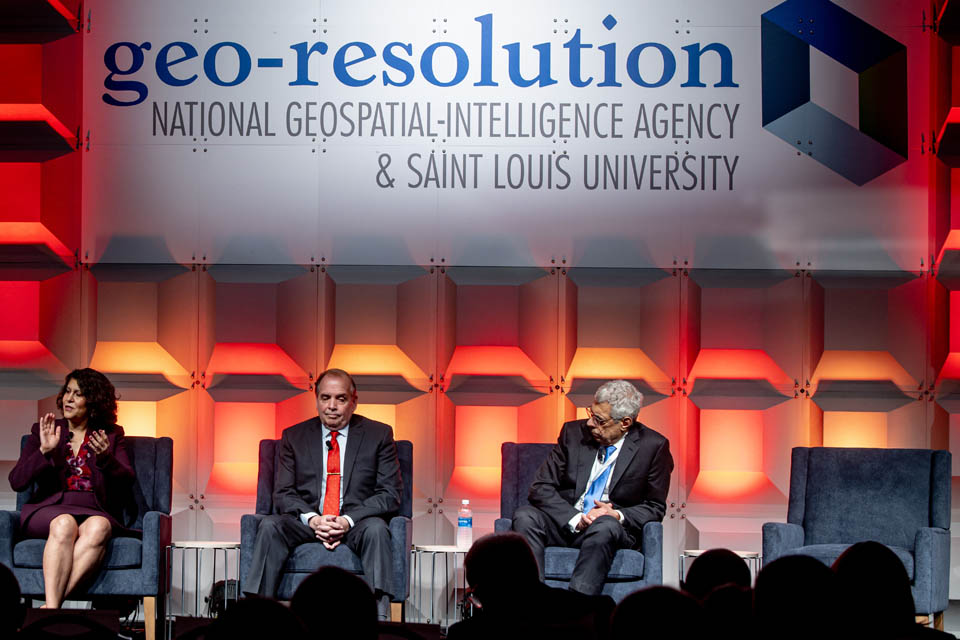
From left, Nadine Alameh, Ph.D., executive director of the Taylor Geospatial Institute, William Caniano, West Executive and director of the office of corporate communications of the National Geospatial-Intelligence Agency, and SLU President Fred P. Pestello, Ph.D., participate in the Leaders Look panel during the Geo-Resolution Conference on September 12, 2024. Photo by Sarah Conroy.
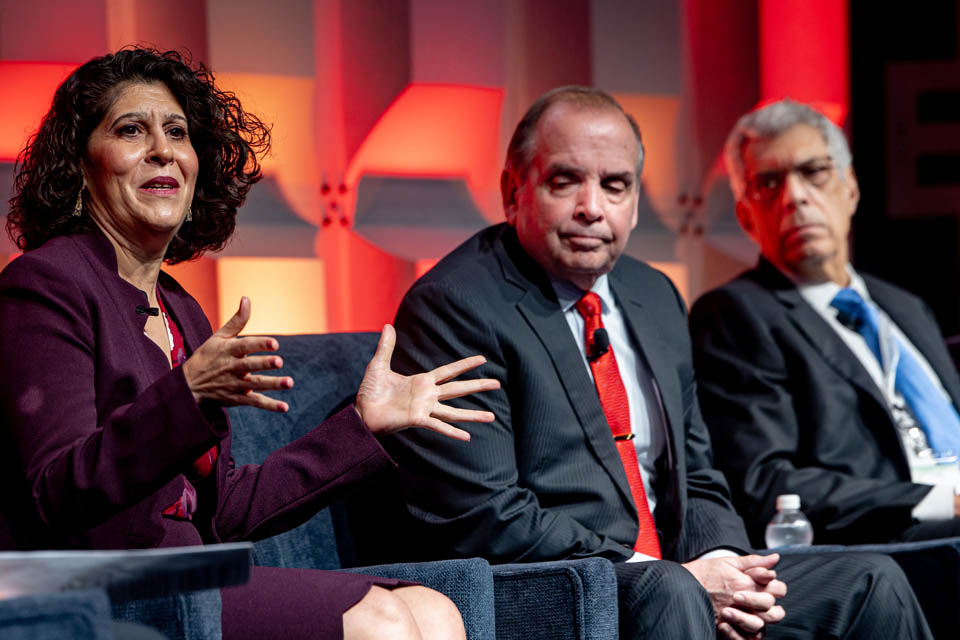
From left, Nadine Alameh, Ph.D., executive director of the Taylor Geospatial Institute, William Caniano, West Executive and director of the office of corporate communications of the National Geospatial-Intelligence Agency, and SLU President Fred P. Pestello, Ph.D., participate in the Leaders Look panel during the Geo-Resolution Conference on September 12, 2024. Photo by Sarah Conroy.
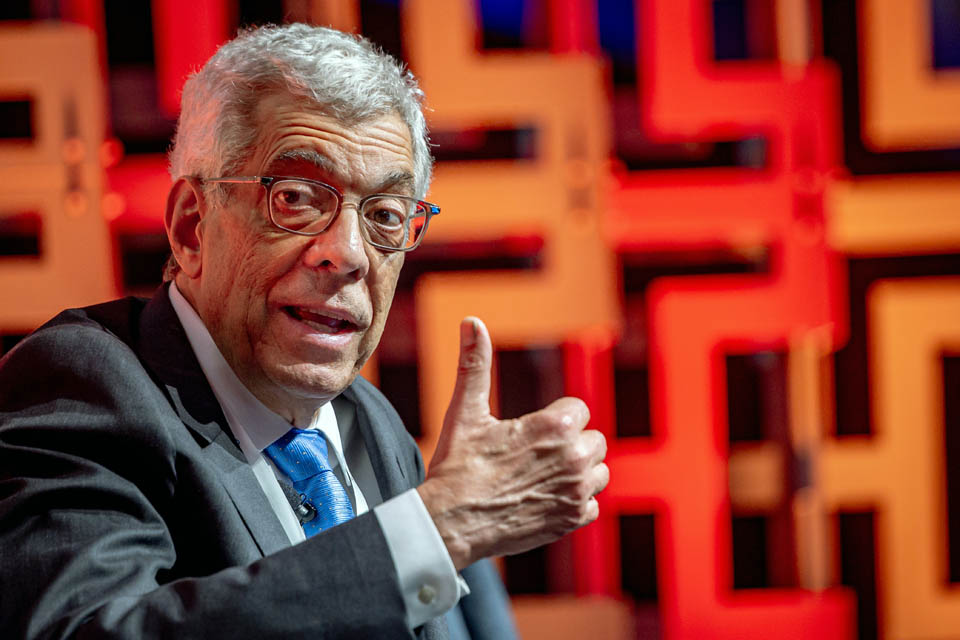
President Fred P. Pestello, Ph.D., speaks on the Leaders Look panel during the Geo-Resolution Conference on Sept. 12, 2024. Photo by Sarah Conroy.
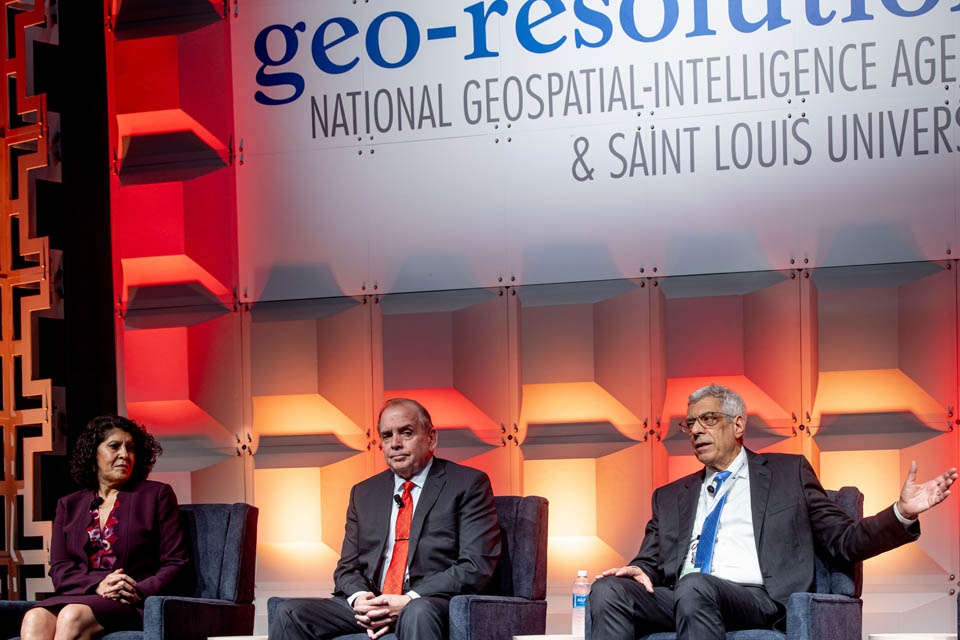
President Fred P. Pestello, Ph.D., right, speaks on the Leaders Look panel with Nadine Alameh, Ph.D., executive director of the Taylor Geospatial Institute, left, and William Caniano, West Executive and director of the office of corporate communications of the National Geospatial-intelligence Agency, center, during the Geo-Resolution Conference on September 12, 2024. Photo by Sarah Conroy.
During the conference’s opening event, the Leaders’ Look panel, SLU President Fred P. Pestello, Ph.D., Taylor Geospatial Institute Executive Director Nadine Alameh, Ph.D., and NGA West Executive and Director, Office of Corporate Communications William Caniano shared their thoughts about the current state of the geospatial industry and looked ahead. All three shared the belief that collaboration would be the key driver for a brighter future.
Caniano spoke about the collaboration between the NGA and SLU to host the annual event which has grown in popularity each year.
“Even before we made the decision to stay in St. Louis, Saint Louis University was actively engaged with us,” Caniano said. “So thanks to them for their support of this and everything that we have done together.”
Pestello noted that the relationship between the two groups made sense. The NGA needs highly-trained people to handle the massive amount of data. SLU sought to build up its geospatial program to help train those future leaders.
Alameh spoke about the ever-changing technology in the world today. With things like artificial intelligence programs, Alameh said there was more data than ever being generated. Everyone, she said, is involved with A.I.
Working for TGI, a SLU-led consortium of eight leading research institutions working together on research into geospatial technology, Alameh has a view of both the academic side of geospatial work as well as the professional aspects. From her point of view, she said moving forward the groups must work together.
“My conclusion when I look at the TGI network of academic research and the industry is that everyone is doing something with A.I.,” she said. It becomes very clear to me is the key is the partnership and the collaboration. … We cannot do this alone.”
Pestello said SLU welcomes the challenge and the collaboration.
“It is ts absolutely critical for any college or university, and we take it very seriously,” Pestello said. “We generate knowledge, we transmit knowledge, and for young people, we apply knowledge. Taking in young people, the future leaders, and the future workforce, is absolutely essential. That means having the right faculty and support staff who can invest in those people and prepare for them intellectually and cognitively, but also in terms of their entire development, so that they are prepared for what they may face in life and work post-graduation.”
All three leaders believed that St. Louis was leading the way in geospatial work. Alameh said the way to keep the momentum going is to inspire the next generation and continue to work together.
“We need to draw them to the magic that is geospatial,” she said. “. . . The NGA created a spark. Universities have created geospatial programs which led to the birth of the Taylor Geospatial Institute, and that’s going to be part of the future roadmap. From the Institute, we’re going to create ideas that hopefully spark innovation.”
Latest Newslink
- Kathryn Mitchell Pierce, Ph.D.: 1955-2025Kathryn Mitchell Pierce, Ph.D., associate professor of educational studies, died Wednesday, Dec. 10, 2025. She was 70 years old. Pierce joined Saint Louis University in 2015 as an assistant professor in the School of Education. Initially a literacy specialist in the undergraduate program, she eventually taught and mentored across all levels at the School of Education. She became an associate professor in 2022.
- Saint Louis University Student Speaks About Leadership and Disability at Ignatian Family Teach-In for JusticeSaint Louis University senior Grace LoPiccolo shared her personal leadership journey at the 2025 Ignatian Family Teach-In for Justice. The event, held annually in Washington, D.C., is the nation’s largest Catholic social justice advocacy day.
- SLU Research Shows Surge in Alcohol-Related Liver Disease Driving ‘Deaths of Despair’Researchers at Saint Louis University School of Medicine say deaths from alcohol-related liver disease have surged in recent years, and the increase is hitting people without a college degree the hardest. While nearly every demographic group is seeing higher death rates—including those with college degrees—the gap between economically disadvantaged groups and more affluent ones is growing, according to new research.
- Saint Louis University Joins Multi-Disciplinary Research Team to Enhance Stress Resilience in SorghumSaint Louis University is part of a multi-disciplinary team, led by the Donald Danforth Plant Science Center, to deepen the understanding of sorghum, a versatile bioenergy crop, and its response to environmental challenges.The U.S. Department of Energy (DOE) Biological and Environmental Research (BER) program supports the three-year $2.5 million project for Genomics-Enabled Understanding and Advancing Knowledge on Plant Gene Function. Saint Louis University will receive $437,039 for its portion of the study.
- SLU Graduates Celebrated at Midyear CommencementSaint Louis University celebrated its Midyear Commencement on Saturday, Dec. 13, inside Chaifetz Arena. More than 1,900 guests watched as 600-plus SLU students walked across the stage and left as graduates.
- Why Do Raccoons Cross the Road? SLU, St. Louis Zoo Research Shows They Don'tA new study led by researchers from Saint Louis University, the Saint Louis Zoo, and partner organizations set out to understand how raccoons use space in one of the nation's largest urban parks.