




Saint Louis University Achieves Prestigious R1 Status, Joining Elite Group of U.S. Research Universities


ST. LOUIS (Feb. 13, 2025) — Saint Louis University has earned the highly revered “R1” designation in the 2025 Research Activity Designations published today by the American Council on Education and the Carnegie Foundation for the Advancement of Teaching.
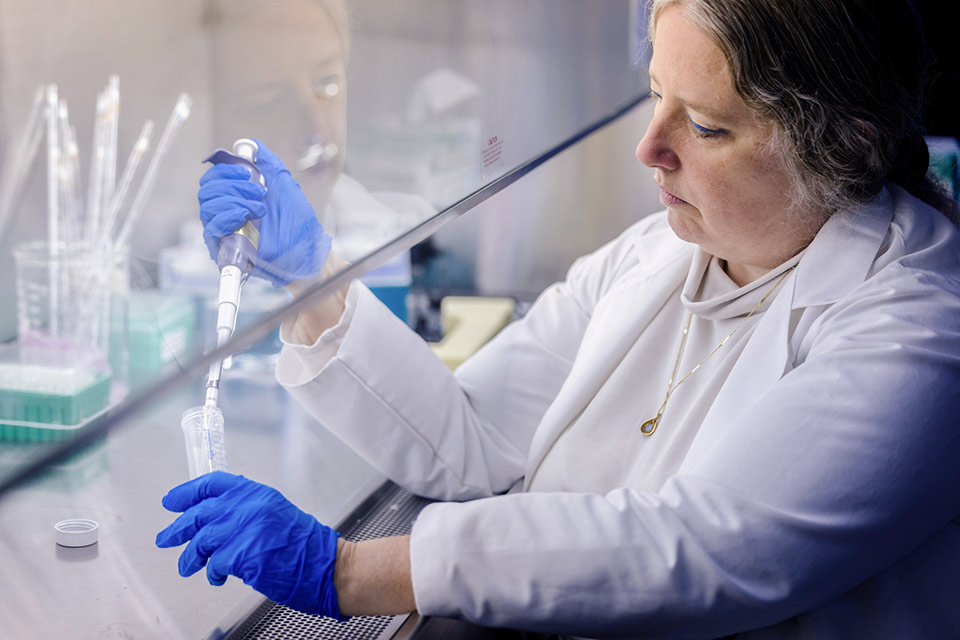
Sarah George, M.D., professor of infectious diseases. Photo by Sarah Conroy.
R1 designation is the highest classification that universities can attain for research activity. With this distinction, SLU joins an elite group of fewer than 190 universities nationwide, affirming its place among preeminent research universities in the United States.
“Achieving R1 status is a historic milestone for Saint Louis University — a testament to the remarkable dedication of our faculty, students and staff who live our Jesuit mission every day,” said SLU President Fred P. Pestello, Ph.D. “This distinction will expand our capacity to pursue truth through life-changing research that serves a higher purpose for the greater good.”
To qualify for R1 classification, universities must spend at least $50 million on research and award a minimum of 70 research doctorates in any field within a single year. SLU has far surpassed these thresholds, reporting $85.9 million in research expenditures and awarding 271 research doctorates in 2023, the most recent year for the Carnegie classification.
SLU’s rise to R1 is the result of a decade-long, institution-wide effort to become a national exemplar for educational and research excellence. Since 2014, the University has focused on creating a robust research environment that fosters collaboration across disciplines and offers new opportunities for faculty and students to explore today’s most urgent challenges.
The University’s rise to R1 status has been accelerated by the generosity of donors who have invested significantly in SLU’s mission to advance knowledge that transforms lives, including a $50 million gift from Dr. Jeanne and Rex Sinquefield (CSB '67) in 2018.
Their historic gift established the SLU Research Institute, which has been a catalyst for research growth at the University, supporting the launch of the Sinquefield Center for Applied Economic Research, SLU’s Water Institute, the Advanced Health Data Institute, the Institute for Drug and Biotherapeutic Innovation, and the Institute for Translational Neuroscience, among others.
“Our ascendance to national research prominence has been nothing short of amazing,” said University Provost Michael Lewis. “The immense generosity of our donors has allowed us to invest boldly in our research enterprise — recruiting top scholars, expanding interdisciplinary collaboration and building the infrastructure needed to accelerate discovery at SLU.”
University leaders believe achieving R1 status is not just a milestone for SLU; it’s a major win for the entire St. Louis region. As an anchor institution for more than 200 years, the University’s rise to R1 status is expected to fuel innovations that address regional challenges and create new opportunities for economic growth and workforce development in St. Louis and Missouri.
“As the first university west of the Mississippi River, SLU has long been a place where bold ideas take root and flourish,” Pestello said. “Becoming an R1 university enhances our ability to attract leading researchers and scholars who will fuel innovations that drive the growth and success of our region, benefiting all of our neighbors and creating opportunities for everyone to thrive.”
SLU researchers are developing new treatments for chronic ailments, advancing vaccines for infectious diseases, and pioneering better approaches for pain management. They’re also enhancing care for aging populations, creating communication tools for the DeafBlind community, studying the safety of Missouri’s bridges, and using geospatial science to address food security and other critical issues.
The University’s prestigious research distinction reflects not only its commitment to groundbreaking discovery but also its ongoing commitment to excellence in teaching, carrying forward the Jesuits’ rich tradition of intellectual rigor and scientific inquiry, which has shaped fields ranging from astronomy to mathematics to seismology.
“For a Jesuit university, research and teaching are not separate pursuits; they are deeply intertwined,” Lewis said. “As we elevate our research profile, we’ll continue to ensure that SLU prepares students to not only become experts in their fields but also compassionate, discerning leaders who will use their knowledge to make a meaningful difference in the world.”
Developed in 1973 by the Carnegie Commission on Higher Education — and currently managed by the Carnegie Foundation for the Advancement of Teaching in partnership with the American Council on Education — the Carnegie Classification is considered the leading framework for categorizing U.S. higher education institutions.
For Carnegie’s classification, research expenditures are reported through the National Science Foundation’s Higher Education Research and Development (HERD) Survey for the years 2021, 2022 and 2023, reflecting the total spending for those years. Research doctorates are reported through the IPEDS Completions Survey, using data from the same three-year period.
About Saint Louis University
Founded in 1818, Saint Louis University is one of the nation’s oldest and most prestigious Catholic research institutions. Rooted in Jesuit values and its pioneering history as the first university west of the Mississippi River, SLU offers more than 15,300 students a rigorous, transformative education that challenges and prepares them to make the world a better place. As a nationally recognized leader in research and innovation, SLU is an R1 research university, advancing groundbreaking, life-changing discoveries that promote the greater good.
Latest Newslink
- Why Do Raccoons Cross the Road? SLU, St. Louis Zoo Research Shows They Don'tA new study led by researchers from Saint Louis University, the Saint Louis Zoo, and partner organizations set out to understand how raccoons use space in one of the nation's largest urban parks.
- Structurally Sound: Two Gingerbread Houses Built by SSE Students Hold Up Under 100-Plus Pounds of WeightTeams of students, faculty and staff in Saint Louis University's School of Science and Engineering recently put their engineering skills to work for a December Innovation Challenge, building gingerbread houses designed to stand up during a weight-loading competition.
- Saint Louis University Student Speaks at Ignatian Family Teach-In for JusticeSaint Louis University senior Sahar Hussaini shared her views on fast consumerism and why she believes in Catholic Ethical Purchasing at the 2025 Ignatian Family Teach-In for Justice. The event, held annually in Washington, D.C., is the nation’s largest Catholic social justice advocacy day.
- SLU Commits up to $1.5 Million to Support Local Students Pursuing Social Work and Criminal Justice CareersThe new initiative — representing a commitment of up to $1.5 million in scholarship support over the next several years — is designed to strengthen the region’s social work and criminal justice workforce by expanding college access for talented local students.
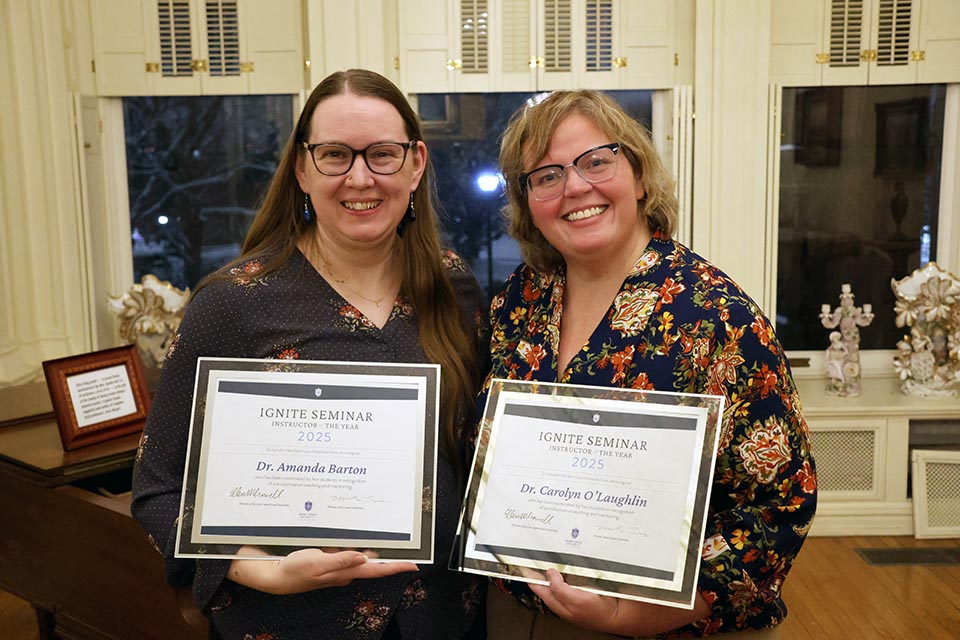
- University Core Honors Ignite Seminar InstructorsTwo Ignite Seminar instructors have been recognized with the 2025 Ignite Instructor of the Year Award. At a ceremony Tuesday night in Cupples House, Carolyn O'Laughlin, Ph.D. (Education) and Amanda Barton, Ph.D. (RISE Counselor) were honored by the University Core after being nominated by students in their Ignite Seminars.
- Sharing Throughout the Season: Ways to Give Back at SLUThis holiday season, Saint Louis University is highlighting organizations that could benefit from the gift of time or donations, including the University's annual Blue Santa toy drive.